

Every year from about the middle of October, the Door and Window Experts Website and the wider door and window trade will start to receive enquiries about window condensation.
Whether it is misted glass, water running down the inside of the frame, or a window with condensation on the outside, that doesn’t seem to clear up until late morning or lunchtime.
Three completely different things get called window condensation, and only one of them means your windows have failed. The difficulty is that homeowners are usually told the opposite of what they need to hear.
The window company sees a sale. The repair man sees a glass unit. But few people are going look at your windows and doors as a whole, what system you’ve had installed, the age and overall condition of your installation and what is going to happen next winter.
Whilst window condensation can mean several things, which one of these means that it’s probably time to consider new windows?
So before you spend anything, let’s have a look at the common causes of condensation.
Condensation on the Outside of the Glass
Water on the outer face of the glass, usually first thing in the morning, usually clearing as the day warms up.
This one is good news and here is why, in detail. It means the outer pane is sitting close to the outside air temperature because the coating and the cavity are keeping your heat indoors.
Older, poorer glazing leaks enough warmth through the unit to keep the outer pane above dew point, so it never mists.
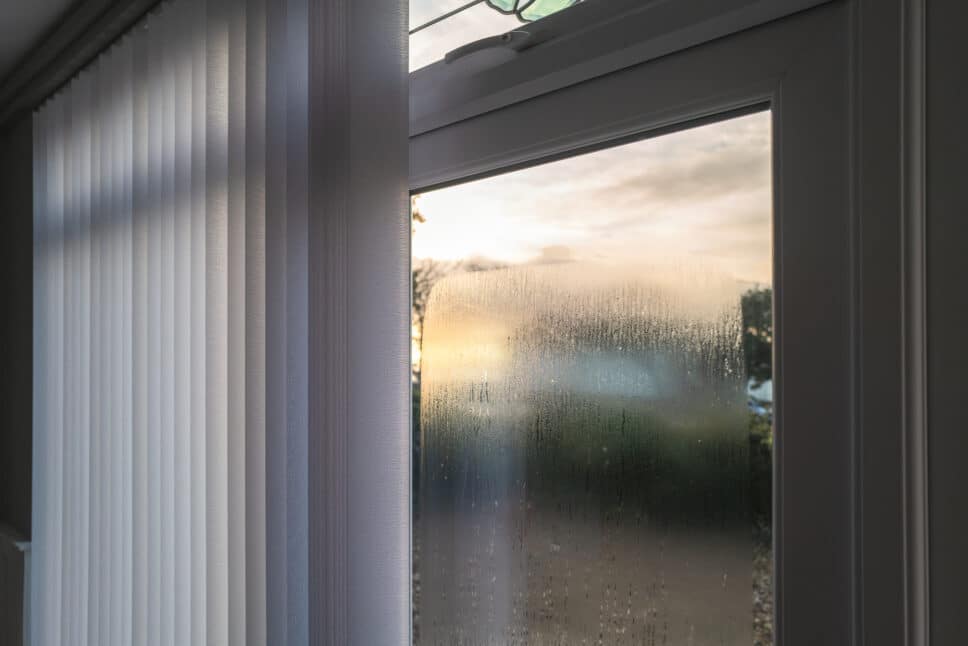
Window Condensation on the Room Side of the Glass
Water on the inside face of the glass, often with water pooling on the frame, sometimes with black mould appearing in the corners of the rebate or on the reveal.
This is moisture in your home meeting the coldest surface in the room. Four people breathing, showers, cooking, washing drying on radiators, a bathroom extractor that has never worked properly, and a house that has been sealed up progressively over twenty years of loft insulation, draught proofing and new doors. The moisture has to go somewhere and the glass is where it shows.
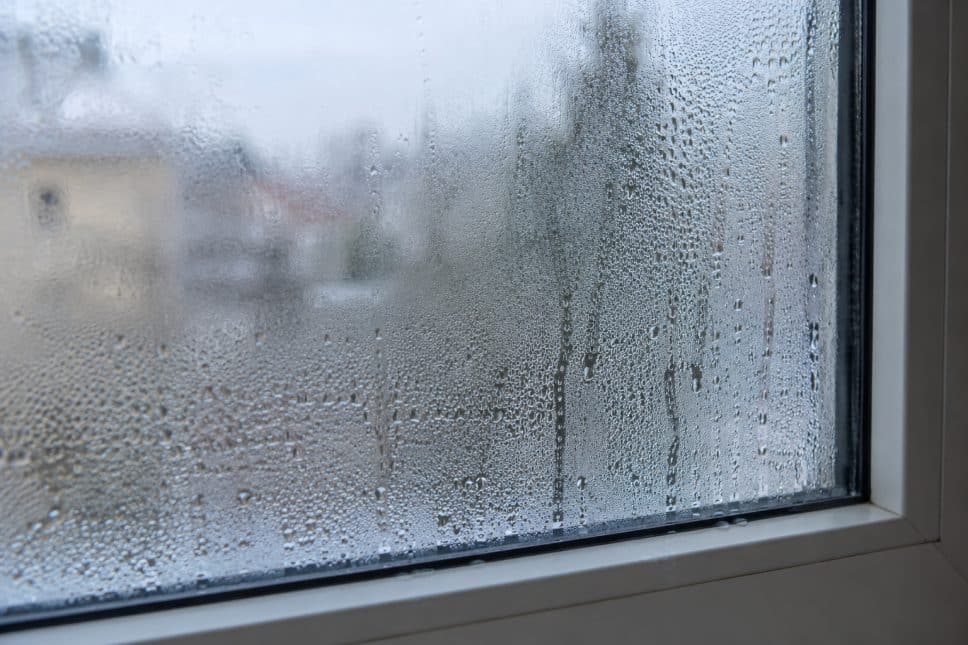
The window is not the fault. But the window tells you how bad the problem is, and an old window makes it worse. Single glazing, or early double glazing with an aluminium spacer bar and a non-thermal or early generation resin thermal break, not polyamde used today, provides a cold surface to condense on at every edge. Modern glass with a warm edge spacer and a properly broken frame runs warmer, so the same amount of household moisture produces far less water.
Deal with the ventilation first. Open the trickle vents and leave them open. Use the extractors and run them on for a few minutes after you finish. Put a hygrometer in the worst room and watch what happens when you change your habits. If you still get water on the glass once the house is ventilating properly, the windows are part of the problem.
Condensation between the panes
Misting, haze, water droplets or a dried white tidemark inside the sealed unit, where you cannot wipe it off.
This is a failed sealed unit. The perimeter seal has lost the fight, moisture has got into the cavity, and the desiccant in the spacer bar is saturated and can no longer absorb it. It is permanent. It will not dry out, and no amount of drilling, venting or injecting will give you back a sealed unit.
That is a glass job, not a window job, and on a reasonably modern window it is a straightforward one.
The question is whether your window is reasonably modern.

Why one failed unit could mean new windows
Assuming you had your windows and doors replaced to your home all at the same time, glass units were almost certainly made in the same week, on the same production line, with the same sealants.
They have been through the same fifteen or twenty winters on the same elevation, depending upon when you bought them. Therefore, when the first units starts to mist up between the panes, you are not looking at bad luck. It could be the beginning of a sequence.
In my experience the South and West elevations go first. Next would be any windows and doors in a sun trap, anything above a conservatory or flat roof, anything unusually large, and the glass in doors or windows that are used the most in your home.
Then the rest follow, usually over the next year or two. If you have had one unit replaced and a second has gone within a year or two, stop treating them as separate repairs. The windows are starting to tell you what stage they are at in their life.
Replace and Don’t Repair. When is it Time for New Windows?
Age on its own does not condemn a window. Plenty of good aluminium from the 1990’s has decades left in it, when windows, glass and the installation were perfect from day one. A well made timber or steel window that has been looked after can outlive all of us. What matters is whether the window can still be maintained.
Age can also be a factor in causing window condensation, because the components that all work together to keep your windows sealed and insulated are not longer fit for purpose. Here is what to consider.
The Age of Your Windows
This is probably the most important factor that’ll tell you it’s time to replace them.
The picture shows a Kent house fitted with Monarch Aluminium windows and doors in the 1990’s. This brand was in my view the best of it’s time. Widely used, tried and tested and still going strong to this day.
However, it was discontinued in 2000-2001. Component parts are no longer availble although some hinges and handles, can be replaced with others. But if any part of the aluminium is damaged, there are no replacements and it’s time to replace.

If your glass units are misted up, it is still possible to replace them. However if any window beads break or are damaged, you won’t find a replacement. For this reason, many glaziers avoid older windows. This is especially the case with older uPVC windows such as Marshall Tufflex, Warmseal, Caradon, early Anglian and 1980’s Everest windows and other now discontinued names.
Replacing glass in a current system is easy. Replacing glass in an obsolete system or an out of business retailer is a different proposition, and this is what you need to identify first.
And remember, brands where not as well known on windows and doors as they are today. If you bought a house with double glazing fitted by previous occupiers, identifying them is virtually impossible.
The Gaskets, Seals and Brushes
The gaskets are another reason to consider replacing your windows and doors. Some were made for the window itself, especially if it has the gasket extruded with the plastic on the bead.
Soft and springy is fine. Hard, shrunken, cracked, pulled back from the corners or gone shiny and flat means it has given up, and it is the gasket that keeps water out of the glazing rebate and off the sealant.
Some glaziers have access to all manner of gaskets that may work in place of the old, but there is always a risk of not being able to find suitable rubbers, brushes or other seals. Early generation bifold doors with the seals at the bottom are a particular problem today.
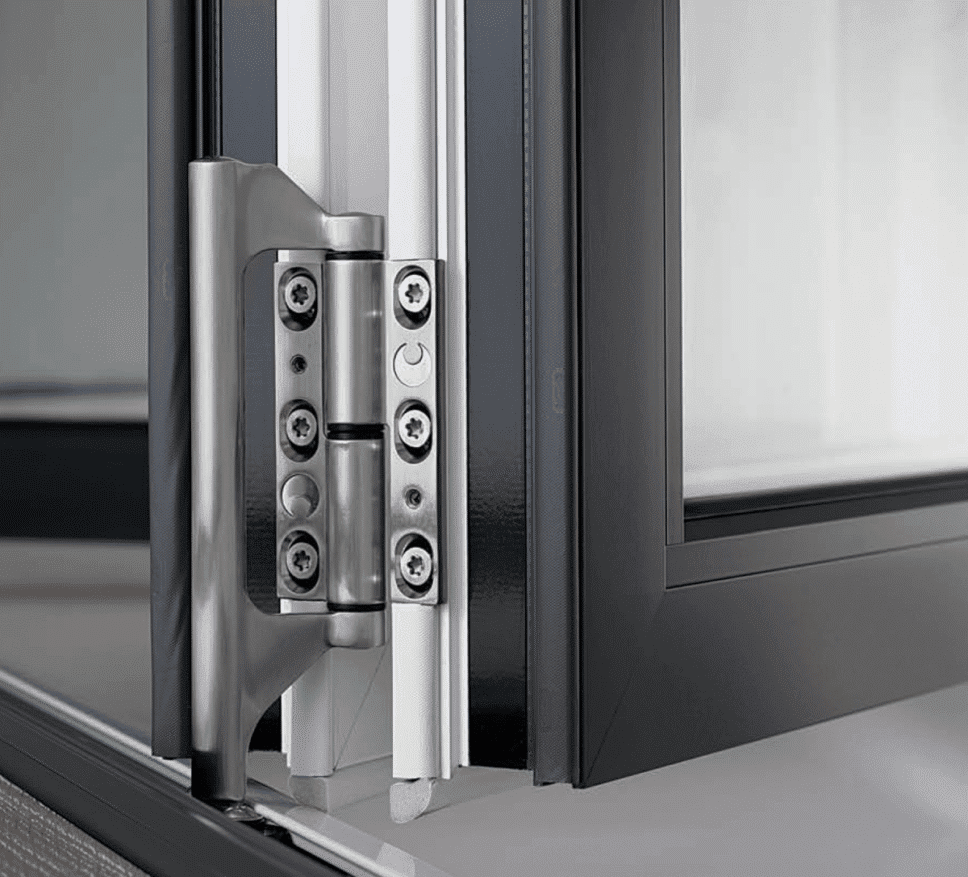
The condition of your frames and finish
uPVC distortion, cracked welds, opening aluminium mitres, deep yellowing or chalking.
Aluminium window coating failures such as filiform corrosion creeping out from the edges, especially within a few miles of the sea.
Timber windows going soft at the bottom rail and the lower corners of the sash, open joints, paint that is failing faster each time.
Steel windows with rust and single glazing that streams with water.

Some products were awkward even when they were current. Early generation VELFAC patio doors are a good example. They were built around a tilt-and-slide mechanism, and once that gear starts to fail you are looking for parts for a product that was discontinued a long time ago.
There are very few people left who will take that work on, and those who would rather not.
It does not help as much as you would hope if the manufacturer is still trading. Systems companies support current systems. They are not set up to supply a gasket for something they stopped extruding in 2011, and they are rarely willing to get involved in a domestic repair that was never their contract in the first place.
Your original installer, if still in business, has the same problem, and after ten years has no obligation and very little incentive.
There is also a quiet point about specification. A unit from 2008 was very often clear float, air filled, aluminium spacer, with a hard coat low emissivity glass if you were lucky.
Replacing it like for like puts you back where you started. Replacing it with a modern soft coat, argon filled, warm edge unit in a frame designed for a 20mm cavity may not fit, may upset the sightline, and will still leave you with an old frame, old gaskets and old hardware around new glass.
So the test is not whether the glass can be changed. It is whether the whole window has a future.
Secondary Glazing and Window Condensation
Secondary glazing sits on the inside of your existing windows and provides improved insulation and comfort. is a genuine option in two situations. A listed building or conservation area where window replacement is not permitted, and a house where the windows are worth keeping but are cold, draughty and noisy.
What it does well is reduce noise, cut draughts, improve comfort at the glass line and do all of it reversibly, without touching the original window. On a period sash window in a city street it is often the better engineering answer than a replacement.

What it does not do is fix a failed sealed unit. It also needs installing with condensation in mind, which is where DIY systems and cheap installations go wrong.
The principle, and it is the same one Historic England sets out in its guidance on secondary glazing for windows, is that the secondary unit should seal well on the room side and the original window should not be sealed.
You want moist room air kept out of the cavity, and you want the cavity to breathe to the outside through the original window. Get it the wrong way round, by draught proofing the original window tightly and leaving the secondary panel leaky, and you will get condensation on the inner face of the original glass, in the one place you cannot reach to wipe it.
Two other practical points. Opening the secondary unit for ventilation in cold weather in a humid room will put water on the original glass, so ventilate another way. And check how the panels come out before you buy, because every secondary glazing installation eventually needs cleaning in the cavity.
Window Condensation and Trickle Vents
Trickle vents are not a design flaw and they are not a draught to be blocked up. They are the background ventilation that stops moisture building up in a sealed house, and closing them in winter, which is exactly when people close them, is how a damp problem turns into a mould problem. You can find out more about trickle vents, what they do and where you need them, but my advice is never close them.
Condensation on Windows. So when is it time to act?
Change the glass and keep the windows
If you know the brand and the age of your windows and whether parts are still available, then you can still repair and change the failed units. A competent glazier and company doing window servicing and repairs, not selling new windows and doors, will tell you whether the window still has parts available.
Plan replacement windows
If your windows are eight-ten years old, more than one sealed unit has misted, a second unit has gone within a couple of years of the first. If the system has been discontinued, the hardware is worn or no longer available, the frames or the coating are failing, or the glass specification is so far out of date that new units would be the only modern part of the window. Then it is time to change.
Do nothing to the windows, and address ventilation and airflow
If the water is on the room side and your ventilation is poor. Sort that out first and see what is left.
If you are somewhere in between, which many people are, the order matters. Get the system identified before you get quotes, because the answer to “can this be repaired” depends entirely on what it is.
Then get the condition of the frames and hardware assessed by someone who is not selling you the replacement. Only then start comparing windows, because a replacement specified in November and ordered in January is a far better job than one bought in a panic in February because the lounge window has gone opaque.
Get in touch if you decide it’s time to replace.
The Door and Window Experts Website does not sell windows and we are not paid to recommend any brands. We provide expert, independent and impartial advice.
If you have misted units, problematic older windows and doors you can’t identify. We can even help sensecheck your window and door quotations. Or if you want to be sure what an installer is telling you is correct. Get in touch, send us your photos of the windows and the glass and we can help.